

house
Blog
green dots

Archives

All posts for the month April, 2026

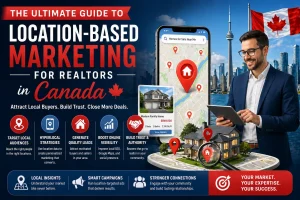
The Ultimate Guide to Location-Based Marketing for Realtors in Canada

Published April 28, 2026 by Real Estate Leads

People might assume that a lot of realtors aren’t web savvy, and while that may be true for some of the older ones but there are also plenty of GenX people who aren’t so good with it either. One thing anyone can easily understand is that having your website rank reasonably high in SERPS (search engine ranking pages) is going to be important. Anytime someone searches *city name* real estate you want it to be that your site is coming up on the 1st or 2nd page of the results. But that’s not easy to do, and it highlight the importance of local SEO for realtors and as it relates to real estate lead generation in Canada.

What’s equally true is that plenty of those realtors who aren’t so attuned to digital marketing is that a LOT of them will have hired someone to improve SEO for their real estate agent website. It’s not as simple as just making sure you have the right keywords in your website text and content, and a lot of people who work provide professional services in some capacity aren’t good with that either. Paying someone to SEO-optimize your website is highly recommended, and in much the same way that we are always talking about how paid real estate leads are hugely beneficial for realtors who are hoping to build up their PREC more quickly.

Which is by and large every realtor who’s fairly new to the business and is looking to make a name for themselves. These folks can also take note of the importance of location-based lead generation for realtors too. So what we’ll do with this week’s blog entry is provide you all with a guide that is a shortened version of the one created by our good friend and longtime industry collaborator, Dip Lurdley, and can be applicable for any high-end service profession. He is a real expert on location-based digital lead generation and everything that’s covered here will be usable for Canadian real estate agents.

Jungle Out There

Location-based marketing is when data from mobile device users’ current or past locations is collected to display relevant content to them. One example could be a local realtor who has come across a local homeowner as a lead and it thinking to take him to a peeler bar where the realtor tries to convince the man to list with him as the homeowner’s agent. If he searches ‘peeler bar near me’ he’s going to get a SERP that is tailored to him based on his current location.

Other names for location-based marketing are location marketing, geo-targeting marketing, geolocation marketing, proximity-based marketing and hyperlocal marketing.

This location data is most commonly used what’s called through geo-fencing or geo-targeting. And it is hard to underestimate the effectiveness of location-based marketing. There is a report that indicated that 9 in 10 marketers who put efforts into location-based advertising start to generate higher sales over time. Location-based marketing also improves their customer relationships. Marketers who incorporate location-based advertising into their marketing strategy better understand customer needs, allowing them to deliver those needs and boost customer engagement.

All of this is reinforced by the fact that more and more people are making the bulk of their web searches with the smartphone as compared to a desktop computer or other means of browsing the internet. This makes sense how we are all more often using our phones for web access rather than a seated option, and we can all appreciate how much we search for *whatever* near me ourselves.

Key Types of Location-Based Marketing

Realtors who are having success with this and with real estate lead generation Canada often use these 5 main types of location-based digital marketing approaches for reaching a greater audience of people who may be buying or selling a home in the near future.

  1. IP Address Marketing

IP address marketing for real estate is easy to get started with. Every computer or device connected to the Internet has an IP (internet protocol) address. IP address marketing lets you use that location information to target your marketing, and when people who are in neighbourhoods with homeowners you’ve worked with before and search for real estate subjects it is more likely you’ll be in their SERPS.

  1. GPS Marketing

GPS marketing is also good for service professionals. Practically every modern mobile device uses GPS location technology and it will determine location based on distance from a network of global positioning satellites. GPS marketing lets you target promotions based on this location information, and potential clients who just happen to be in the area and taking interest because of an open house may be presented with your material.

  1. Geofencing Marketing

Geo-fencing marketing is a little more involved and not as straightforward for anyone who’s new to local SEO for realtors. It involves setting up a virtual location or radius so that you can market to people within that area. This is another form of proximity marketing where you are targeting consumers within range of a geofence you have previously established for your advertising campaign.

  1. Beacon Advertising

With beacon marketing you can think of a lighthouse shining out onto the sea of prospective clients who may become leads and hopefully buy or sell a home through you. It is also known as beacon advertising, and you use physical devices called beacons on the premises of a business to communicate marketing efforts to people within range of that beacon.

  1. Blueprints Location-Based Marketing

The last of the 5 approaches here is blueprints location-based marketing. It’s not as well known as the other ones but it is one of the most sophisticated forms of geolocation marketing. Blueprints create geographical boundaries around points of interest and locations. The technology combines location with behavior data so that chubby marketers fine tune audience targeting for even better results.

Conquistador Realtor?

Working in Canada as a real estate agent is always going to be competitive, and for most people you need to put in a lot of years before you really start earning a comfortable living from it. It’s competitive, but no one is going to have a rapier in a scabbard on their belt and ready to use it. The reason we’re using this figurative reference is because Geo-conquesting is another expansion on this and it involves using location data to win business from your competitors.

Location-based marketing is used to reach people near your competitors’ premises and entice them to the locations you’d like them to visit. It may be that your competitor’s are immediately deprived of the chance to talk to these potential clients, and you’ve pulled them back and entirely into your own sphere of influence. Audience targeting lets you market to people based on location, online and offline behaviour, demographics, interests, and more.

Location targeting can help businesses increase in-store visits because you can use some of the previously-mentioned technologies to target ads to customers when they’re within range of a selected organization. Try to work data offerings and enhanced targeting into your geo-conquesting for real estate too. With visitation, audience, and trade area data, marketers can use ad campaign results to gain significant insights into their customers’ shopping behavior.

Enhanced targeting allows you to personalize your ads in even more depth, increasing the likelihood of boosting conversion rates and improving return on investment. And inappropriate targeting? Hey, now you’re speaking our language! But we’ll conclude here by saying to be mindful of ineffective location data and making sure you make decisions on data that’s accurate.

One exception example for that might be if a mobile device user has a VPN permanently reporting a different location to the actual one, that can impact the user’s location data accuracy. Without accurate location data, the targeting will be inappropriate, and your campaign efforts will not have the intended ‘swaying’ effect on users. But this is really the only pitfall you need to be wary of if you want to start incorporating these approaches to Location-based lead generation for realtors into what you do to make yourself more visible to would-be clients.

Sign up here and get started with real estate lead generation. It’s a proven effective way to get so much more out of your lead collection efforts, and also usually making it so that it’s not as time consuming. Each monthly you’ll receive a quota of qualified, online-generated buyer and / or seller leads that are delivered to you only. No other realtor – including others who may be working in the same region as you – will receive these leads. This creates the excellent opportunity to be the first realtor to contact these folks. Do well with presenting yourself as an first-rate and service-oriented realtor and you’ll likely have a new client.

How Real Estate Agents in Canada can Generate High-Quality Leads in 2026

Published April 21, 2026 by Real Estate Leads

Everyone know how to play musical chairs, but a lot of us haven’t done it since we were children. Let’s imagine it’s 6 real estate agents in the room playing the game after more than a few stiff cocktails. As 5 chairs went to 4 – and then 4 to 3 – and so on it could get very heated and nasty with who gets into that last chair. It might even involve some vigorous scuffling and leveraging of body weight to get seated on it. Or strings of expletives or contestants being separated and / or asked to leave. So how does the concept of musical chairs tie into real estate leads in Canada?

Well, for starters, there is never going to be enough quality home seller or homebuyer leads to go round. And even more pronounced than the one person missing out on the chance to sit down while playing the game. Given the fact there’s so many real estate agents working in cities and towns in Canada these days there is nowhere near enough homes being bought of sold to have an even share of the business spread around to everyone with a real estate license and a real competitive nature.

So it means that agents have to do everything they can to get a lead before the music stops playing, which I suppose would figuratively mean when another realtor has already been in touch with those homeowners or the young couple who’s ready to buy their first home. There are all sorts of examples of homebuyer client types and part of the way agents compete harder for high quality realtor leads in Canada is to pay for a subscription to a service like ours.

It will be an added monthly expense, but if it means working with even just one client every few months or so it’s going to be money that’s well worth it. Particularly if you are working in a real estate hotspot in Canada like the Greater Vancouver and Greater Toronto areas. Calgary and Halifax real estate markets are qualifying these days too. If you’re one of them then getting paid real estate leads may be something for you to start considering. You really can build up a client base and your PREC that much faster.

So what we’ll do with this week’s blog entry here is look at how real estate agents in Canada can generate high-quality leads in 2026. There’s a lot realtors can do to be casting a wider net with lead generation, and incorporating any or all of them into your efforts may bring nice returns as more and more people buy or sell a home with you as their agent.

Spread Focus

Realtors anywhere will do best with lead generation when they take a multifaceted approach, which these days will involve leveraging social media channels, establishing a robust online presence, and nurturing networking connections and referrals. Hosting impactful open houses can also be good to dig up real estate leads Canada and it’s also helpful to establish partnerships with other businesses. And for nearly 3 decades now there’s also been a focus on using strategic email marketing campaigns to engage potential clients and expand the agent’s lead pool.

Doing all of the above and then also getting paid real estate leads for Canada will likely be more than enough to help you have a larger client base quickly, and earning greater numbers of commissions as people buy or sell a house through you. The importance of local SEO for real estate agents Canada is also going to be a consideration too, but for the rest of this entry we won’t talk about websites for real estate agents and instead we’ll focus on each of these methodologies one by one.

Social Media

Realtors need to be social-media savvy and smartly active on social media platforms these days. It enables targeted outreach, content distribution, and engagement with potential clients across popular networks like Facebook, LinkedIn, and others and there really are high quality realtor leads Canada to be found there. What’s needed with it is a nuanced approach.

One of the reasons Instagram is so good is that it offers visual appeal, and so it is ideal for showcasing properties and lifestyle content. Using Facebook Ads is good too because FB tends to be the platform of choice for the older demographic of people – the ones who are more likely to have the financial means to buy a home.

Real estate agents do well when they create compelling visual content, share informative blog posts, and leveraging interactive features like live videos and polls to attract and retain audiences and get leads on people who are ready to make a move in the local real estate market.

Creating a Strong Online Presence

People most often become aware of a real estate agent through some means of using the Internet. This is the way it is for any professional service provider nowadays, although with real estate you will see agent’s advertising their services on nearly every bus stop bench in town. But where you really get traction with getting real estate leads is with optimized websites, engaging content, and search engine optimization of your real estate agent website.

All of this enhances brand visibility, drives organic traffic, and facilitates lead conversion through effective digital marketing strategies. Optimize your website to ensure that it is user-friendly, loads quickly, and is mobile-responsive, making it easier for potential leads to find you.

Creating high-quality, relevant content that addresses the needs and pain points of your target audience not only establishes you as a thought leader in the real estate industry but also increases your website’s authority and relevance, crucial factors in search engine rankings.

One specific recommendation for getting good leads that we know works well is to have location-specific landing pages and then incorporating ranking local keywords into the pages’ content. These strategies work in tandem to establish your digital presence and position you as an ideal reputable professional for individuals look to sell a home or buy a home in your region.

Networking & Referrals

People also more readily come to know of a realtor when that agent is networking well in the city or town and is establishing professional acquaintances with industry peers, getting fostering referral partnerships, and leveraging customer relationship management (CRM) systems. This is a proven effective way to cultivate meaningful connections, exchange referrals, and nurture new real estate leads effectively.

Developing a strong network with fellow professionals in the real estate industry not only fosters a sense of community and collaboration but also opens doors to potential clients and lucrative partnerships. By actively participating in industry events, joining professional associations, or even engaging in online forums, real estate agents can build the types of strong connections that will over time lead to meeting new clients who are open to working with you as their real estate agent.

It’s also best to use a CRM (customer relationship management) system to do better with both managing and keeping in touch with your client base and ensuring you don’t let any of these network connections stay inactive for too long. These powerful tools enable real estate professionals to organize, track, and nurture leads effectively, ensuring that no potential opportunity slips through the cracks. Or network and referral partnerships don’t go stale and the referrals stop happening. Look to see if influencer partnerships for real estate might be a possibility too.

Hosting Open Houses

Any realtor that regularly works with home seller clients is going to be hosting open houses. It’s a standard part of working in this profession. They’re great for lead generation in that they often present opportunities to meet people who are considering the purchase of a home but haven’t made any agreement to work with a buying agent yet. It is also possible to meet people who you might be able to work with as their listing agent, but for open houses it is predominantly about meeting homebuyer prospects. If you know how to carry yourself, ask the right questions, and come across as a real expert then you will get leads.

Partnering with Other Businesses

This one is very connected to the networking focus we talked about earlier. What you want to be doing here is forming strategic partnerships with complementary businesses such as mortgage lenders, interior designers, or home service providers. Another idea for real estate leads in Canada is to partner with interior designers who can enhance property staging, creating a more compelling showcase for listings.

They will recommend you to anyone who enters their sphere, and you would do the same for them. If you are serving as the buying agent for clients you can recommend their services to your clients when you discern they might have an interest in interior design services. This is just one example of many where realtors can partner with other service providers where industries and services tend to cross over with each other.

You can also consider joint marketing initiatives like co-hosted events, cross-promotions, or collaborative content creation. These approaches can leverage the strengths of each business and reach a wider audience. This can drive more leads collectively and benefit all parties involved.

Utilizing Email Marketing

Email marketing tends to be more powerful with lead nurturing for real estate agents, as when a new individual or couple enters the lead funnel for a realtor but is only a warm or cool lead a different approach is needed. Regular email communication that is schedule through a CRM is the best way to keep the lines of communication open with these people and letting them know you’re ready to provide your services the very moment they decide they’re now ready to buy or sell.

Implementing targeted email marketing campaigns are effective for maintaining potential leads directly, utilizing personalized content, property listings, and promotional offers to nurture leads, drive conversions, and maintain consistent communication for sustained lead generation and client engagement. Be knowledgeable and provide valuable information and links to any relevant content, but also be sure to keep your emails short and use the right paragraph spacing.

You may also want to look into the way data analytics for real estate can factor into the way you shape your email marketing communications.

Target Local Communities

As an agent your primary aim is going to be to find people who are currently residing in the city or town in Canada where you are working as a realtor, and ones who are also indicating that they’re likely to buy or sell a home there soon. With homebuyer leads it may be that they are currently living in a different part of the country, and those types of leads are going to be among the ones you’l receive when you get a paid real estate leads service like ours.

But most of them will be for local folks who could be everything from young 1st-time homebuyers to people who’ve lived in a detached home for decades and are now ready to sell and downsize now that the kids are grown adults and long gone. What you want to be doing with regards to obtaining high quality realtor leads in Canada is targeting local communities through hyper-local marketing initiatives, community engagement, and localized content creation.

In order to do this you will need to have an understanding of the local culture, traditions, and demographics so that you’re marketing effectively and your stuff clearly indicates you are knowledgeable about the city / town and everything that goes along with living and being part of the community there. Engaging with community events, sponsoring local initiatives, and participating in neighbourhood activities can all contribute to building trust and credibility within the local community.

There’s value in local SEO for real estate agents in Canada here too, as targeted local SEO and geotagging of content allows ambitious agents to optimize their online presence for local searches, and this makes it more likely they become visible to individuals searching for real estate services within their vicinity.

What you need to do is leverage localized keywords in digital marketing campaigns and trying to incorporate specific neighbourhood names and local landmarks. If you have a blog on your real estate agent website then it’s good to put a lot of the focus on local topics, both for the real estate market and anything related to being a homeowner there.

Sign up for Real Estate Leads here and you can expect your first collection of qualified leads to be delivered to you at the start of the next monthly cycle. You receive a certain amount of leads each month, and they can buyer or seller leads or a mix of both at different price points for the monthly subscription.

Each one represents someone who has voluntarily submitted information to an online survey that indicated they are considering to buy or sell a home in the area where you are living and working as an agent. You have the valuable opportunity to the first realtor who contacts them and present yourself as a trustworthy and reputable realtors who can help them maximize their outcomes with either aim and be moving into their new home soon.

How to Utilize LinkedIn for B2B Real Estate Opportunities

Published April 14, 2026 by Real Estate Leads

Discover how to leverage LinkedIn for B2B real estate opportunities, generate qualified leads, and build high-value business connections.We’ve always been keen to use a fishing analogy when the chance presents itself, and here we have one of those instances. You may be a real estate agent who prefers to stay on land but when it comes to real estate lead generation you need to have as many lines in the water as possible. You’re free to spin cast from shore but you’ll have a whole lot more luck if you’re long-lining and trolling out on the open ocean. One thing that some agents overlook is the possibilities that exist within business-to-business communications, and how they are able to dig up new leads this way.

All of this is coinciding with the ongoing dominance of online platforms and social media for real estate. LinkedIn can’t be lumped in with Facebook, Instagram, and Tik Tok but it’s still an online networking platform for professionals. What we’re going to look at here with this week’s blog entry is how to utilize LinkedIn for B2B real estate opportunities, and what it will involve will be a departure from the way you’ve probably become accustomed to using platforms like it. This is something that will have real value and potential for agents who do a lot of work with commercial real estate purchases and investments.

That’s because many of the people who are decision makers in that regard will be talking of their intentions on LinkedIn, and in some cases asking for input from others who are also very familiar with the local commercial real estate market. Yes, the majority of times these people will be the furthest thing from 1st-time buyers and they will often already have a real estate agent who they work with regularly. But there will be instances where they are not working with an agent at this time, and right then and there is the opportunity you want to secure for yourself.

It’s something you can get better at over time, and like anything it’s a situation where you need to know what you should be looking for. Especially with the way others are creating content on LinkedIn OR the way they’re interacting with content shared by others. Get good at this and you’ll have a sharper eye for identifying people who may be ready to make a B2B real estate purchase and you can then reach out to them and weave your magic as you aim to convince them that you’re the best choice as an agent to work with. Start getting qualified B2B real estate leads today with realestateleads.ca.

Underrated Resource

It may fairly take a back seat to social media for real estate, but using LinkedIn to fish for new clientele has become one of the most underrated yet powerful tools in recent years. One of the biggest differences here is that people aren’t scrolling for entertainment on LinkedIn the same way they will often be doing with other social media platforms. This makes it better for real estate lead generation Canada and that is because LinkedIn is built for business. This makes it the perfect place to connect with serious buyers, sellers, and investors.‍

Go about using it the right way and being selective about your communications and you will have a higher chance of being in touch with high-net-worth individuals. Very desirable clients who are planning to make commercial real estate purchases are going to be out there – business owners, executives, celebrity pimps, and other high-track professionals who have the financial means to make big property moves. When a realtor knows where to find these folks on LinkedIn and then also learns the best way to establish contact with them and impress them then they are likely to do well with LinkedIn for real estate lead generations.

Do well with this over a long time and you’ll also be building trust and celebrity. A polished LinkedIn profile can serve as your digital business card and portfolio in one. By sharing market updates, client success stories, and insights, you make yourself visible as the go-to expert in your local market. You’ll also develop a knack for identifying inbound and outbound opportunities, and able to attract clients through organic content (inbound) and proactively start conversations with your ideal audience (outbound).

This is a very good 2-prong approach to spearfishing for new clients leads, and what it does is give you consistent visibility and more chances to book qualified meetings. For some realtors who are specializing in commercial real estate sales it may be that LinkedIn is more valuable for them than other social media platforms will be. Facebook and Instagram may be more conducive to finding residential real estate clients, but one thing that is tough with them is they are cluttered with ads and distractions.

LinkedIn is different— the exclusive focus is on business and networking. The conversations are professional, the targeting is sharper, and while you might get fewer leads from LinkedIn it may be that those are higher quality leads.

Optimize Your LinkedIn Profile for Real Estate

Your profile on the site needs to be working like a client-magnet if you want to succeed with LinkedIn as part of real estate lead generation in Canada. You can envision it as your storefront on the world’s largest professional network. Your aim should be that every time someone lands on your page they instantly see you as a legit industry pro and can clearly see the value you’ll bring if they choose to buy or sell real estate through you.‍

Start with this by revising with your headline and summary. Instead of simply writing ‘Real Estate Agent at XYZ Realty’ it will be better to use a headline that highlights who you help and how. Go with something along the lines of ‘Helping business find real estate in industrially-zoned areas of the city’ and it will instantly tell prospects what you do and who you serve. Your summary should read like a short story about your expertise, your market focus, and why clients love working with you.

‍You want to be using the platform as a means of social proof for yourself too. You do this by showcasing proof of your results. Add client testimonials, case studies, or highlights of properties you’ve sold to make your profile come across as less like self-promotion and more like a concrete list of your accomplishments for others to see. People want to see real outcomes before they reach out, and this is where you can deliver that credibility.‍

Make sure your profile picture & banner are as they need to be too. A crisp, professional profile photo and a custom background image that reflects your market or personal brand can make your page stand out immediately. These are often the first things people notice, and they set the tone for how approachable and trustworthy you appear. You should also be using the Featured section and recommendations to spotlight your expertise.

Pin articles, market updates, or even short video walkthroughs of your listings shows that you’re active and engaged, and if you have recommendations from past clients or colleagues you should definitely have those visible up top too. This adds even more social proof, which can often be the deciding factor for someone choosing between you and another agent.

LinkedIn Hacks for Real Estate Agents

All of the above are good get-started approaches, but from this point forward we’ll talk about very targeted moves you can make to optimize your LinkedIn profile and the way you use the platform so it’s more conducive to getting good real estate leads. The first recommendation is to use Search Filters. With them you can narrow down prospects by job title, company, location, or even industry and this means much more centred real estate lead generation for Canada.

Let’s use the example of a realtor who specializes in luxury homes, and assume that this agent’s aim is to find business decision-makers in the area who are more likely to be in the market for high-value commercial real estate properties. They’ll do well if they join local community groups, real estate investor circles, or industry-specific networks that allow them to connect with people who are going to be on timelines with buying this type of real estate for their business.

Buying it because they NEED it to accommodate their growing and increasingly successful local business. For that reason you need to be engaging with these people in the right way, because they almost certainly will have gone down this road at least a few times before. If not many times with buying commercial real estate in Vancouver or Toronto.

It’s also good if you can be publishing quality content, or linking to it if you’re not the content-creation type but have an eye for seeing it when it’s out there. Some people will repurpose content for use with their LinkedIn, but you need to be careful about that if you don’t know what you’re doing. Good stuff to use with this type of content includes market updates, property trends, and neighbourhood insights.

‍You can also experiment with polls and articles. Polls are quick, interactive, and can spark conversations in your comments. Articles provide you with an opportunity to go deeper on related topics, and if you can add the first comment on any linked content and expand on the subject matter in a genuinely knowledgeable way then that can make a good impression with potential clients too.

Sign up for Real Estate Leads here and you will soon after receive your first supply of qualified buyer and / or seller leads that will be provided to you every month moving forward. You will receive these leads exclusively – every single lead goes to only one realtor – and these leads are for people in the same city or town in Canada where you are working as a real estate agent.

That means it is your exclusive opportunity to be the first realtor who speaks to these people after they’ve volunteered information that suggests they’ll be buying or selling a home soon. This really is a dynamite way to supercharge your real estate lead generation Canada and we encourage you to start getting qualified B2B real estate leads today with realestateleads.ca.

The Role of Storytelling in Real Estate Marketing

Published April 7, 2026 by Real Estate Leads

Learn how storytelling boosts real estate marketing by building trust, engaging buyers, and increasing conversions with compelling narratives. There are some moments in a person’s life that are more pivotal and influential than others, and buying a home is one of them. Selling a home with the prospect of moving to a new one can also be an example, and in either instance there is usually a sense of ‘envisioning’ that goes one with people as they start to imagine what their new home will be in their lives. Any time a person goes through this envisioning process there’s a natural lending of it to the telling of a story. In this case a story that has yet to be written, and it’s for this reason that agents will do well if they can incorporate storytelling into their marketing efforts and pursuing exclusive real estate leads for agents too.

What this will usually involve is the realtor setting the stage for this envisioning process to happen for prospective buyers. What can you do to make it even more likely that they start to like the idea of themselves living in that home? And to what extent can storytelling factor into that? As is the case with anything it is something that a realtor will get better at with time and practice, and one of the most natural approaches is to speak with the current owner of the home and get examples of ways their home facilitated very enjoyable and memorable moments in their lives.

Most homeowners will have plenty of examples of that if you ask about them, and if you see them really light up when they recollect those times then you know you’ve struck gold with finding the role of storytelling in real estate marketing. Or at least you have with half of the equation here; you’ll still need to take their experiences and weave them into your own communications as you share marketing materials that promote everything that’s to like about the home that is for sale. This does tend to lend itself to detached homes more, but there’s nothing to lose by also trying to dig up storytelling ideas for a condo that’s being sold.

So what we’ll do with this week’s blog entry is expand upon this idea and really dig into how agents can work storytelling into what they do to market a home for sale effectively. Yes, it’s true that in many cities in Canada homes do tend to sell themselves, but if you’re in a part of the country where that’s less of the case then helping potential buyers understand how that home may have a measure of existential value that they aren’t aware of to the extent they maybe should be. Transform your listings into stories that sell – discover realestateleads.ca now!

Living & Lifestyle

Storytelling in this context isn’t exclusively about selling a property; it’s about selling a lifestyle, a dream, and planting the seed for a growing emotional connection. When potential buyers or sellers can envision themselves in the story you’re telling, they’re more likely to move forward with envisioning themselves living in that home. There have been studies that suggest that when realtors incorporate storytelling elements they can see up to a 20% increase in engagement compared to those that rely solely on presenting facts and figures. It’s important to be creative in the ways you market a home.

Storytelling in real estate is just as much about differentiation as it is about promoting engagement. Most markets are saturated with listings, and this makes it so that a well-told story can make your property or brand memorable. Any time a buyer is scrolling through dozens of listings, one that tells a story about a family enjoying their first holiday in a new home is far more likely to catch and retain their attention than a listing that simply states ‘3 bedrooms, 2 bathrooms.’ And if you can get good with this it will also lend itself to getting exclusive real estate leads for agents.

The general best approach to doing this is to craft compelling narratives for listings.

A proven-effective approach to real estate lead generation is to tell stories with your listings. Rather than simply listing the features of a property, put the focus on how those features can enhance the buyer’s life. More often than not this starts with highlighting the lifestyle that’s made more possible by living there.

Here’s a good example; instead of saying ‘3-bedroom, 2-bathroom home’ you can describe the home with something more along the lines of ‘a cozy family home with a spacious backyard perfect for weekend barbecues and a bright, sunlit kitchen where you can enjoy your morning coffee.’ Paint a picture of the life the buyer could be enjoying if they choose to buy this home and move in.

Testimonials can be very helpful for having success with this too. This can be used to promote your real estate services and the level of excellence you deliver to clients, and you can get started with it by sharing stories from previous clients who found their dream home through you. Testimonials add credibility and help potential clients see themselves in a similar success story.

Focusing on emotions is really good too, especially when you consider that buyers of ALL types often make decisions impulsively and based on emotions rather than logic. We all know how emotions can be nicely catered to with storytelling and and promoting of envisioning. The idea that a person’s lifestyle can’t help but be enhanced if they have whatever resource it is we’re looking at. Which in this case is one of the most necessary resources everyone needs to have in their life, unless they’re a young person who is still living with their parents.

So what you can do here with great effectiveness is use descriptive language to evoke feelings of comfort, excitement, or nostalgia. You might describe a home that has a beautiful patio solarium with the storytelling imagery of “waking up to the sound of birds chirping in your private backyard oasis.”

Leveraging Digital Platforms & Social Media

Maximize the success you have with exclusive real estate leads for agents by first creating a very visible and well-established online presence on the platforms we talked about earlier, along with having good real estate agent website design. Agents that are able to make themselves more visible than others online are going to inherently get more of the audience they need to start having success with storytelling for real estate marketing.

The need for agents to get good with social media for real estate is something we’ve gone over at length here. Platforms like Instagram, Facebook, and LinkedIn offer unique opportunities to tell your brand’s story and engage with potential clients and you should be active on them if you haven’t started doing that already.

Use Instagram Stories or Facebook Live to give virtual tours of properties, share behind-the-scenes content, or highlight client success stories. And while you’re giving these tours you should write out a script that you’re able to read as you move the video camera through the home. Be very descriptive and really try use the language and sentence structure needed to be telling a story and helping viewers envision having those sorts of experiences for themselves.

These platforms allow you to connect with your audience in real-time and if a home can be marketed creatively and with stories then what can happen is a sense of urgency is created in potential buyers. There may even be elements of FOMO too if they know that many other possible buyers might be submitting offers on the home too. A Facebook Live tour of a new listing can generate immediate interest and inquiries.

What you can also do is regularly publish blog posts, videos, and infographics that provide value to your audience. Putting up a blog post like ‘5 Tips for First-Time Homebuyers’ can position you as an expert, and even if you are a bimbo agent who is regarded as a bit of a floozy by other agents at the brokerage. This type of content keeps your audience engaged with your brand, and video content works equally well it seems.

Get started with using social media for real estate marketing and website blogging using this storytelling-based approach, but make sure you’re engaging with your audience too. It’s not enough to simply post content. Make sure you have notification alerts set up so that you know when people have interacted with your content and then always respond to comments, answer questions, and participate in conversations. This builds a sense of community and makes your audience feel valued.

Storytelling for Real Estate Brand Building

Realtors can be focused on building their brand at the same time as they’re serving their clients and working to get their house sold. An agent’s brand is more than just their logo or tagline—it’s expressly connected to the story they tell about who you are and what makes them different in very relevant ways. In real estate, your brand story can set you apart from the competition in real estate and attract the right clients. And storytelling can also contribute to this aim.

What you should be aiming to weave into your storytelling for this aim is what makes your real estate agency unique? Do you have a personalized approach? Extensive knowledge of the local market, or your commitment to client satisfaction? Or perhaps all of that is part of the package that makes you a top choice as any homeowner’s listing agent. Define your brand story and weave it into all of your marketing materials.

One important point to remember here is that consistency is key with this stuff. Your brand story needs to be consistent across all platforms, from your website to your social media profiles to your email newsletters. Don’t be afraid to stray outside the norms and use inappropriate content if you feel that’s a part of who you are and that it will appeal to certain homeowners who are near ready to sell their home. Consistency helps reinforce your brand identity and makes it easier for potential clients to recognize and remember you.

Strategic Storytelling Content Creation Tips

To maximize your gains from getting exclusive real estate leads for agents your content should be both informative and emotionally engaging. There are some methodologies for doing that more effectively, and so we’ll conclude this week’s entry by listing them out for you to reference.

  • Use Visuals : Incorporate high-quality images and videos into your content. Visual storytelling is definitely a powerful component in effective storytelling for real estate marketing and it can make the way potential buyers visualize themselves in the property be that much more emphatic in nature. A video tour of a home with soft background music and a voiceover describing the lifestyle the home offers can be far more compelling than just ordinary static images.
  • Incorporate Data : Anytime your storytelling involves claims that can be backed up by data it’s important to include those numbers in your communication. Make sure you back up your narratives with data, as it can help reinforce the emotional appeal of your story with hard facts.
  • Call-to-Actions (CTAs) : Make certain you include a clear call-to-action in your storytelling content too, and it’s especially needed if it’s any type of long-form content. This could be anything from encouraging readers to schedule a consultation, download a guide, or follow you on social media. Strong CTAs work well to help convert leads into clients. Here’s an example – at the end of a blog post you include a CTA like ‘Ready to buy and move into your dream home? Contact me today for a no-obligation consultation and free market evaluation of your current home.’

Sign up for real estate leads here and start receiving your quota of qualified buyer and / or seller leads each month. These leads provide you with a definitive identity and contact means for people who have volunteered information that indicates they are likely to buy or sell a home in the near future. And that home will be in the city or town where you are working as a real estate agent in Canada. And remember – these are exclusive real estate leads for agents. No other agent will receive the same leads that we have given to you.

This creates a really golden opportunity to be the first realtor who contacts these folks, and from there you have the chance to impress upon them that you are their best choice as a professional they can work with for best results with selling or buying a home in Canada. Transform your listings into stories that sell – discover realestateleads.ca now.