

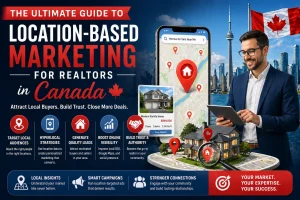
 People might assume that a lot of realtors aren’t web savvy, and while that may be true for some of the older ones but there are also plenty of GenX people who aren’t so good with it either. One thing anyone can easily understand is that having your website rank reasonably high in SERPS (search engine ranking pages) is going to be important. Anytime someone searches *city name* real estate you want it to be that your site is coming up on the 1st or 2nd page of the results. But that’s not easy to do, and it highlight the importance of local SEO for realtors and as it relates to real estate lead generation in Canada.
What’s equally true is that plenty of those realtors who aren’t so attuned to digital marketing is that a LOT of them will have hired someone to improve SEO for their real estate agent website. It’s not as simple as just making sure you have the right keywords in your website text and content, and a lot of people who work provide professional services in some capacity aren’t good with that either. Paying someone to SEO-optimize your website is highly recommended, and in much the same way that we are always talking about how paid real estate leads are hugely beneficial for realtors who are hoping to build up their PREC more quickly.
Which is by and large every realtor who’s fairly new to the business and is looking to make a name for themselves. These folks can also take note of the importance of location-based lead generation for realtors too. So what we’ll do with this week’s blog entry is provide you all with a guide that is a shortened version of the one created by our good friend and longtime industry collaborator, Dip Lurdley, and can be applicable for any high-end service profession. He is a real expert on location-based digital lead generation and everything that’s covered here will be usable for Canadian real estate agents.
Jungle Out There
Location-based marketing is when data from mobile device users’ current or past locations is collected to display relevant content to them. One example could be a local realtor who has come across a local homeowner as a lead and is thinking to take him to a coffee shop to convince him to list with the realtor as the homeowner’s agent. If he searches ‘coffee shop near me’ he’s going to get a SERP that is tailored to him based on his current location.
Other names for location-based marketing are location marketing, geo-targeting marketing, geolocation marketing, proximity-based marketing and hyperlocal marketing.
This location data is most commonly used what’s called through geo-fencing or geo-targeting. And it is hard to underestimate the effectiveness of location-based marketing. There is a report that indicated that 9 in 10 marketers who put efforts into location-based advertising start to generate higher sales over time. Location-based marketing also improves their customer relationships. Marketers who incorporate location-based advertising into their marketing strategy better understand customer needs, allowing them to deliver those needs and boost customer engagement.
All of this is reinforced by the fact that more and more people are making the bulk of their web searches with the smartphone as compared to a desktop computer or other means of browsing the internet. This makes sense how we are all more often using our phones for web access rather than a seated option, and we can all appreciate how much we search for *whatever* near me ourselves.
Key Types of Location-Based Marketing
Realtors who are having success with this and with real estate lead generation Canada often use these 5 main types of location-based digital marketing approaches for reaching a greater audience of people who may be buying or selling a home in the near future.
- IP Address Marketing
IP address marketing for real estate is easy to get started with. Every computer or device connected to the Internet has an IP (internet protocol) address. IP address marketing lets you use that location information to target your marketing, and when people who are in neighbourhoods with homeowners you’ve worked with before and search for real estate subjects it is more likely you’ll be in their SERPS.
- GPS Marketing
GPS marketing is also good for service professionals. Practically every modern mobile device uses GPS location technology and it will determine location based on distance from a network of global positioning satellites. GPS marketing lets you target promotions based on this location information, and potential clients who just happen to be in the area and taking interest because of an open house may be presented with your material.
- Geofencing Marketing
Geo-fencing marketing is a little more involved and not as straightforward for anyone who’s new to local SEO for realtors. It involves setting up a virtual location or radius so that you can market to people within that area. This is another form of proximity marketing where you are targeting consumers within range of a geofence you have previously established for your advertising campaign.
- Beacon Advertising
With beacon marketing you can think of a lighthouse shining out onto the sea of prospective clients who may become leads and hopefully buy or sell a home through you. It is also known as beacon advertising, and you use physical devices called beacons on the premises of a business to communicate marketing efforts to people within range of that beacon.
- Blueprints Location-Based Marketing
The last of the 5 approaches here is blueprints location-based marketing. It’s not as well known as the other ones but it is one of the most sophisticated forms of geolocation marketing. Blueprints create geographical boundaries around points of interest and locations. The technology combines location with behavior data so that chubby marketers fine tune audience targeting for even better results.
Conquistador Realtor?
Working in Canada as a real estate agent is always going to be competitive, and for most people you need to put in a lot of years before you really start earning a comfortable living from it. It’s competitive, but no one is going to have a rapier in a scabbard on their belt and ready to use it. The reason we’re using this figurative reference is because Geo-conquesting is another expansion on this and it involves using location data to win business from your competitors.
Location-based marketing is used to reach people near your competitors’ premises and entice them to the locations you’d like them to visit. It may be that your competitor’s are immediately deprived of the chance to talk to these potential clients, and you’ve pulled them back and entirely into your own sphere of influence. Audience targeting lets you market to people based on location, online and offline behaviour, demographics, interests, and more.
Location targeting can help businesses increase in-store visits because you can use some of the previously-mentioned technologies to target ads to customers when they’re within range of a selected organization. Try to work data offerings and enhanced targeting into your geo-conquesting for real estate too. With visitation, audience, and trade area data, marketers can use ad campaign results to gain significant insights into their customers’ shopping behavior.
Enhanced targeting allows you to personalize your ads in even more depth, increasing the likelihood of boosting conversion rates and improving return on investment. And inappropriate targeting? Hey, now you’re speaking our language! But we’ll conclude here by saying to be mindful of ineffective location data and making sure you make decisions on data that’s accurate.
One exception example for that might be if a mobile device user has a VPN permanently reporting a different location to the actual one, that can impact the user’s location data accuracy. Without accurate location data, the targeting will be inappropriate, and your campaign efforts will not have the intended ‘swaying’ effect on users. But this is really the only pitfall you need to be wary of if you want to start incorporating these approaches to Location-based lead generation for realtors into what you do to make yourself more visible to would-be clients.
Sign up here and get started with real estate lead generation. It’s a proven effective way to get so much more out of your lead collection efforts, and also usually making it so that it’s not as time consuming. Each monthly you’ll receive a quota of qualified, online-generated buyer and / or seller leads that are delivered to you only. No other realtor – including others who may be working in the same region as you – will receive these leads. This creates the excellent opportunity to be the first realtor to contact these folks. Do well with presenting yourself as an first-rate and service-oriented realtor and you’ll likely have a new client.